The 1952 Washington Invasion:
When UFOs Outmaneuvered America’s Air Defenses and the Government Rushed to Explain Them Away
In the summer of 1952, the United States was gripped by Cold War anxiety. The Korean War raged, the Soviet Union tested nuclear weapons, and the nation’s capital suddenly found itself under what appeared to be an aerial incursion —not by enemy bombers, but by objects that no one could identify. Over two consecutive weekends in July, radar operators at Washington National Airport and Andrews Air Force Base tracked dozens of unidentified targets maneuvering with impossible speed and precision through restricted airspace directly over the White House, the Capitol, and other sensitive sites. Fighter jets were scrambled. Pilots watched the objects accelerate away or vanish when pursued. Multiple radar systems and trained eyewitnesses confirmed the events in real time.
This was the Washington, D.C. UFO flap—one of the most thoroughly documented and embarrassing episodes in the early history of the modern UFO phenomenon. What happened that July exposed not only the limitations of America’s air defenses but also the government’s instinct to prioritize public calm over candid answers.

Washington Newspaper Clipping
Flotilla of UFO’s Pass Over Washington D.C. - July 1952
Radar Doesn’t Lie—Until the Air Force Says It Does
On the night of July 19–20, 1952, senior air traffic controller Harry G. Barnes was on duty at Washington National Airport. Around 11:40 p.m., controller Edward Nugent picked up seven unidentified blips on his radar, located about 15 miles south-southwest of the city. The objects were not on any flight plan. Their movements were “completely radical compared to those of ordinary aircraft,” Barnes later recalled. They darted at speeds that made continuous tracking difficult, hovered, and changed direction abruptly.
Controllers at the airport’s tower and at Andrews Air Force Base reported the same targets. Visual observers described bright orange lights or “orange balls of fire” that streaked across the sky and stopped dead. When two F-94 Starfire jet interceptors were finally scrambled from New Castle Air Force Base in Delaware, the objects vanished from radar just before the jets arrived—only to reappear once the fighters, low on fuel, departed. Barnes and others suspected the objects were monitoring radio traffic. The pattern repeated.
The Washington Flap: 1952 Wave of UFO Sightings
The Press Conference That Changed Nothing
By late July, the story dominated headlines nationwide. The Air Force, facing public alarm and questions about national security, convened one of its largest press conferences since World War II on July 29. Maj. Gen. John A. Samford, Director of Air Force Intelligence, stood before reporters and offered a single, tidy explanation: temperature inversion. Layers of warm air over cooler air, he said, had bent radar waves and created false echoes. Visual sightings were dismissed as stars, meteors, or ground lights.
The explanation was convenient. It was also contested almost immediately. The U.S. Weather Bureau noted that any temperature inversion present was too weak to produce the “good and solid” returns described by controllers. Radar operators insisted the blips behaved like physical objects under intelligent control. Project Blue Book’s own director, Capt. Edward Ruppelt, had been rushed to Washington but later acknowledged the official line satisfied few of the people who had been on the scopes that night.

Air Force Declares Saucers Harmless
In the end, the Air Force classified many of the Washington sightings as “unknowns,” yet publicly maintained the weather story. The message was clear: nothing to see here, move along.
Why the 1952 Flap Still Matters
The Washington flap was not an isolated curiosity. It occurred at the peak of the 1952 UFO wave, when Project Blue Book logged hundreds of reports in a matter of weeks. It involved simultaneous radar and visual confirmation by professional military and civilian personnel. The objects demonstrated performance characteristics—extreme acceleration, instantaneous stops, apparent awareness of pursuing aircraft—that remain characteristic of the most credible UFO reports today.
What stands out is the institutional response. Faced with a genuine national security incident in restricted airspace, the priority was not full disclosure or rigorous investigation but rapid narrative control. The temperature inversion story became the template for decades of official dismissals. Public interest was cooled, congressional scrutiny was avoided, and the files were quietly archived.
Today, with the Pentagon’s own UFO (a.k.a. UAP) reporting programs and congressional hearings acknowledging that some aerial phenomena defy conventional explanation, the 1952 events deserve fresh scrutiny. They remind us that skepticism of extraordinary claims is healthy—but so is skepticism of extraordinary official denials when the evidence, from multiple independent systems and witnesses, points in a different direction.
It is beyond comprehension that the US military, the media, and involved government officials want us to believe the radar operators and all the corroborating witnesses are incompetent. They are all just like Barney Fife (can’t find their way out of a paper bag with both ends open). It is little wonder that the public has and still is losing trust in our American institutions. I don’t blame them. The many explanations offered for UFO sightings down through history are laughable at best. On top of that, there is no good explanation for why the government still classifies (locks up information/reports about UFOs vs our military behind a wall of secrecy) all the real, actual, factual UFO events, especially the ones that involve the military (who —by all accounts— have the best data on UFOs collected by the best sensors American money can buy).
The skies over Washington in July 1952 did not belong to the U. S. Air Force that night. Whoever—or whatever—held the advantage, it was not the United States military. Seventy-four years later, we are still waiting for a straight answer about what, exactly, out-flew our best interceptors right over the seat of American power.
Sources and further reading include declassified Project Blue Book files, contemporary newspaper accounts, eyewitness statements preserved in the National Archives, and analyses from historians of the era. The full record remains a powerful case study in how governments handle the unknown when it appears directly overhead.
Project Blue Book’s Official Explanation of the 1952 Washington, D.C. Flap:
A Convenient Weather Story That Never Quite Fit
In July 1952, the U.S. Air Force faced one of its most public and embarrassing UFO crises. Multiple nights of simultaneous radar tracks and visual sightings over restricted airspace directly above the White House, Capitol, and Andrews Air Force Base triggered national headlines and forced a rare large-scale Pentagon response.
Project Blue Book, the Air Force’s official UFO investigation program (then only months old under Capt. Edward J. Ruppelt), ultimately aligned with the public explanation delivered by Maj. Gen. John A. Samford, Director of Air Force Intelligence, at the largest Pentagon press conference since World War II on July 29, 1952.
The Official Explanation:
Samford and supporting officers attributed the radar returns to **temperature inversions** — layers of warm, humid air trapped above cooler air near the ground. This meteorological condition can cause “anomalous propagation,” bending radar waves and creating false echoes or “ghost targets” that appear as solid blips. Visual sightings were dismissed as misidentified stars, meteors, or city lights distorted by the same atmospheric effects. [See a summary of **temperature inversions** at the end of this article]

Maj. Gen. John A. Samford
A subsequent Civil Aeronautics Administration (CAA) technical analysis reinforced this, stating that a temperature inversion had been present “in almost every instance” when the unidentified radar targets or visual objects were reported. Project Blue Book’s final case files labeled the Washington radar blips as false images caused by temperature inversion and the lights as conventional phenomena.
The message was clear: no threat to national security, no exotic technology, and certainly nothing extraterrestrial. The explanation served its immediate purpose — it calmed public anxiety during the height of the Cold War and the Korean conflict.
Critical Weaknesses and Contemporary Doubts
The temperature inversion theory quickly faced push-back from the very professionals who had been on duty:
Radar operators’ testimony: Senior controller Harry G. Barnes and others described the blips as strong, solid returns — not the weak, fuzzy echoes typically associated with anomalous propagation. The targets moved in coordinated patterns, hovered, accelerated rapidly, and appeared to react to the presence of interceptors (disappearing when jets arrived and reappearing after they left). Multiple independent radar systems (Washington National Airport tower, Andrews AFB, and others) showed the same targets.
Ruppelt’s own reservations: Even Blue Book director Edward J. Ruppelt, who initially floated the inversion idea internally, later documented in his book “The Report on Unidentified Flying Objects” that many radar and control tower personnel he interviewed strongly disagreed with the official explanation. Some Air Force officers were equally unconvinced.

Capt. Edward J. Ruppelt
Meteorological limitations: Critics, including later analysts, noted that while inversions existed, they were relatively weak on those specific nights and insufficient to produce the clear, persistent, high-speed targets reported. Inversions do not typically create targets that behave with apparent intelligence or correlate so precisely with visual observations by trained pilots and ground observers.
The explanation also failed to address why the objects repeatedly entered restricted airspace over the nation’s capital on two consecutive weekends, prompting jet scrambles ordered at the highest levels.
Internal vs. Public Stance
Declassified records reveal a gap between public messaging and internal assessment. While the press conference and subsequent Blue Book filings emphasized conventional explanations, many of the Washington cases were carried as “unknowns” in the project’s files. This pattern — minimizing publicly while privately retaining some cases as unexplained — became characteristic of Blue Book’s approach. The priority appeared to be narrative control and public reassurance rather than exhaustive scientific openness.
Legacy and Modern Perspective
Project Blue Book’s handling of the 1952 Washington flap set a template for decades of official UFO explanations: attribute what you can to known phenomena, downplay the rest, and emphasize that nothing threatens national security. The temperature inversion story was widely accepted by the media at the time and helped deflate the 1952 UFO wave.
Yet the case remains one of the strongest in the historical record because of the convergence of multiple radar systems, visual corroboration by credible witnesses, and the objects’ demonstrated performance. Even today, with the Pentagon’s modern UFO (now relabeled UAP) investigations and congressional interest, the 1952 events are frequently cited as an example where the official explanation strained credulity (to say the least).
In the end, Blue Book’s explanation was bureaucratically successful — it quelled panic and closed the public file — but scientifically and evidentially incomplete. It left the most compelling details of the Washington flap unresolved, a pattern that would repeat for years to come.
Temperature Inversions & Radar Anomalies
A radar temperature inversion (more precisely called anomalous propagation —caused by a temperature inversion—) is one of the most common meteorological effects that can create false or misleading targets on radar screens.
What Is a Temperature Inversion?
Under normal conditions, air temperature **decreases** with increasing altitude (roughly 3.6°F per 1,000 feet). This is called the environmental lapse rate.
A temperature inversion is the opposite: a layer of **warmer air sits on top of cooler air** near the surface. This creates a sharp boundary where the normal decrease in temperature reverses.
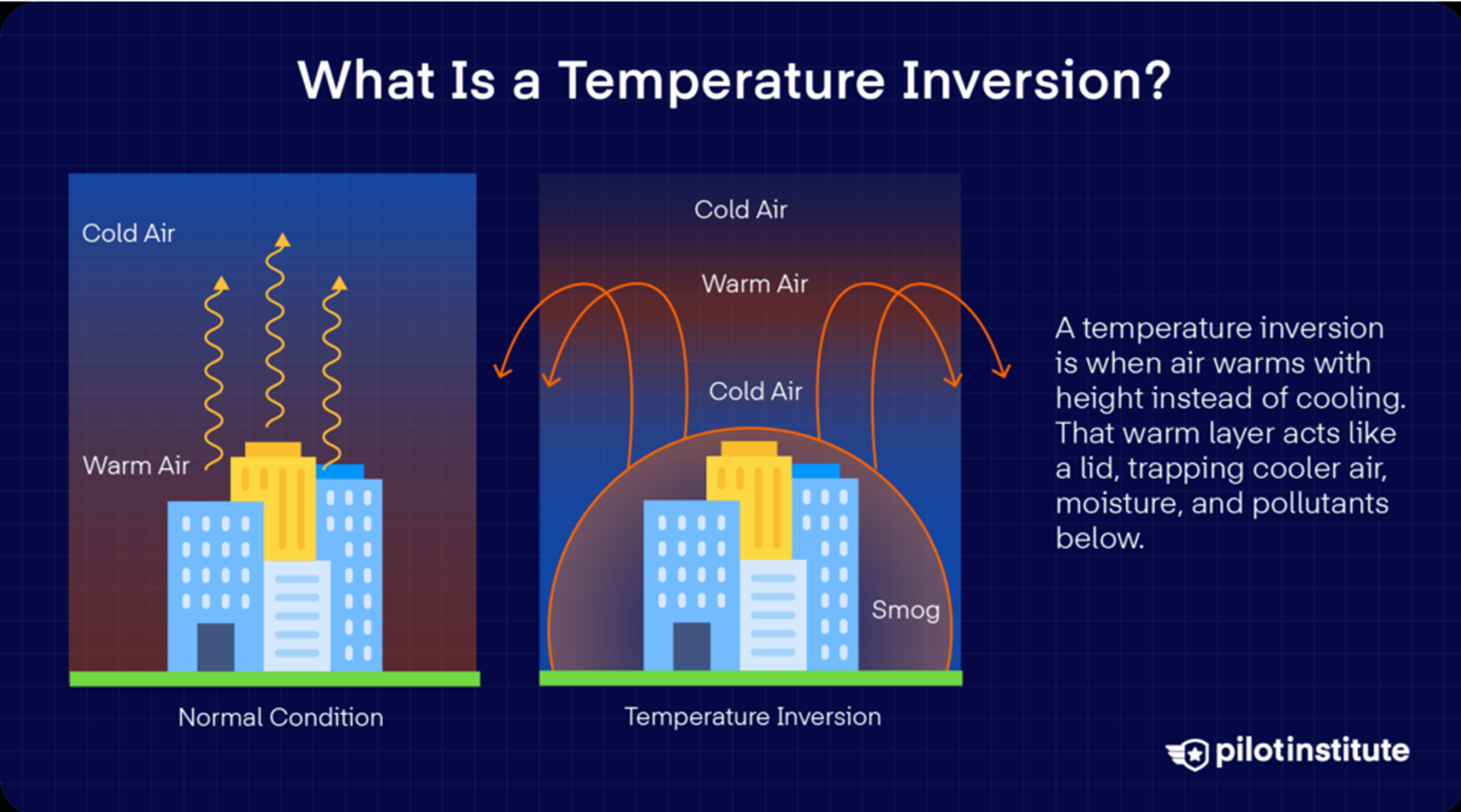
Temperature Inversion Graphic Illustration
Common causes include:
- Clear, calm nights (radiation inversions)
- Cool air flowing over warmer water (marine inversions)
- Subsidence from high-pressure systems
- Frontal boundaries
The inversion layer acts like a “lid” in the atmosphere.
How Temperature Inversions Affect Radar
Radar works by sending out microwave pulses that travel in (mostly) straight lines and bounce back from objects. However, radar waves are refracted (bent) by changes in air density.
In a temperature inversion:
- The warmer air above cooler air creates a sharp change in the **refractive index** of the atmosphere.
- This causes **super-refraction** or **ducting**: the radar beam bends downward more strongly than normal and can follow the curvature of the Earth for much longer distances.
- Signals can become trapped in an “atmospheric duct” between the ground (or sea) and the inversion layer.
Normal propagation → Radar beam goes straight or slightly curves with the Earth’s curvature (standard range).
Inversion-induced propagation → Beam bends sharply downward → detects ground objects or distant targets far beyond normal horizon → creates false echoes.
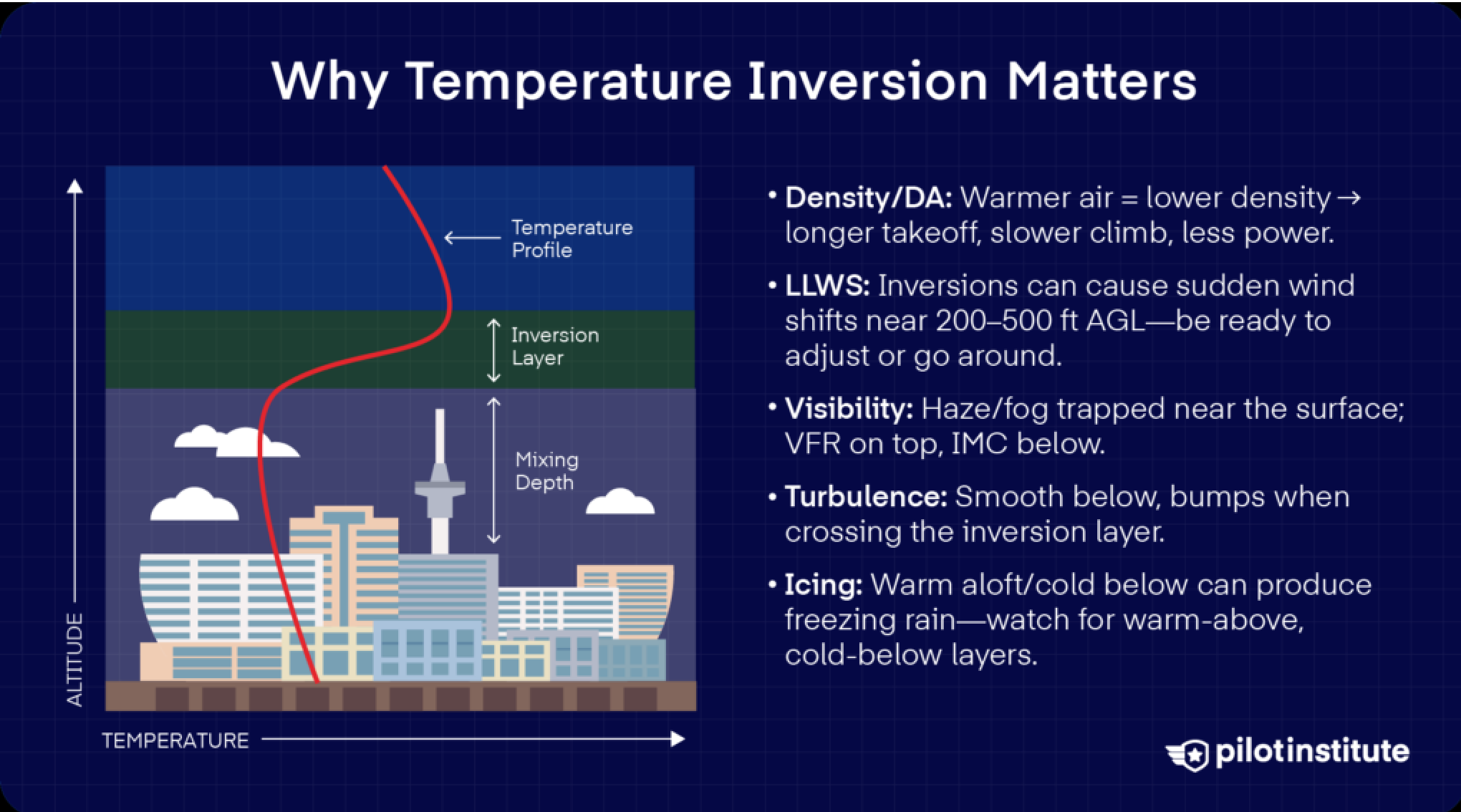
Why Temperature Inversion Matters Infographic
How It Shows Up on Radar
Temperature inversions can produce several distinctive effects:
- False “ghost targets” or “angels” — Strong, solid-looking blips that appear to move but have no corresponding visual object.
- Extended ground clutter — Ground returns (buildings, terrain, sea) appear much farther away than they should.
- Apparent moving targets — Because the ducting can be patchy or change with time, the false echoes can appear to speed up, slow down, hover, or make abrupt direction changes.
- Multiple or smeared returns — Signals bounce repeatedly inside the duct, creating repeated or stretched echoes.
- Targets that “disappear and reappear” — When the inversion layer shifts or breaks, the false targets can suddenly vanish.
Key Point in the 1952 Context
The U.S. Air Force’s official explanation for the famous Washington, D.C. radar sightings was that a temperature inversion caused anomalous propagation, producing the solid, fast-moving blips on multiple independent radar systems. Radar operators at the time strongly disputed this, insisting the returns were too strong, too well-defined, and moved too intelligently to be mere weather artifacts. Not to mention that these same radar operators were never fired or removed from their positions (based on their incompetence as described by nearly everyone involved). The "higher-ups" (Gen. Samford, Gen. Ramey, and others) saw fit to denigrate the multiple Radar Operator's skill at interpreting the targets, yet did not require that they be removed from their positions due to their apparent incompetence.
Note —rant incoming: This pattern repeats in nearly every case where information concerning UFOs vs our military leaks, or military witnesses come forward with information that is in direct conflict with the authoritative explanation for UFO incidents. The authorities claim incompetence of the military personnel involved, but never replace those people, or remove them from their position. The "Roswell Incident" is a perfect example of this pattern. Maj. Jessee Marcel (Roswell Army Airfield Base Intelligence Officer for the 509th Atomic Bomb Squadron —the only Atomic Bomb Squadron in existence) was witness to debris that he held in his hands and claimed was "not of this world". His superiors (again Gen. Ramey) claimed he mistook a "weather balloon" made of rubber, balsa sticks, and foil material as debris from a crashed UFO (this is a claim of utter incompetence). Again, this points out that the authorities are painting their subordinates in positions of great importance as incompetent, yet those individuals did not get removed from those positions of authority based on their incompetence, and in fact got promoted and retired with full retirement pay. —end of rant (for now).
In summary:
A temperature inversion is simply warm air sitting atop cooler air. On radar, it bends the beam abnormally, turning distant or ground objects into apparent airborne targets that can look remarkably like real aircraft — or, in some interpretations, something more unusual.
SOURCES:
Here are key news articles and coverage related to the 1952 Washington, D.C. UFO flap (also called the Washington National Airport sightings or “Saucers Over Washington”). This event in July 1952 sparked a nationwide media frenzy, with front-page headlines in major papers and wire services. Contemporary reporting focused on radar detections, visual sightings by pilots and controllers, jet scrambles, and the Air Force’s eventual temperature inversion explanation.
Contemporary Newspaper Coverage (July 1952)
The sightings made headlines across the U.S., often with sensational language about “flying saucers,” “disks,” and mysterious objects over the White House and Capitol.
- Buffalo Evening News (July 29, 1952): “SAUCERS WHIRL AROUND CAPITAL 6 HOURS” — One of the most dramatic headlines, part of a collage of national coverage highlighting radar and visual reports.
- Cedar Rapids Gazette (July 1952): “SAUCERS SWARM OVER CAPITAL” — A widely cited front-page example that captured the public alarm.
- Washington Post (late July 1952): “Radar Spots Air Mystery Objects Here” and front-page stories on July 28. The paper reported on radar blips over restricted airspace and pilot confirmations.
- New York Times (July 22, 1952): “Flying Objects Near Washington Spotted by Both Pilots and Radar” — Detailed simultaneous radar and visual sightings, noting objects moving at varying speeds and prompting Air Force investigations.
- Fitchburg Sentinel (Fitchburg, Massachusetts, July 29, 1952): Coverage of the Washington D.C. UFO incident, including early reports of flying saucers.
Other notable reports:
- Monroe News-Star (Louisiana, July 21, 1952): Quoted pilot Capt. S.C. “Casey” Pierman describing objects as “like falling stars without tails” but much faster.
- Various papers (e.g., Akron Beacon Journal, Daily Independent-Journal): Included public speculation (Russian secret weapons? Extraterrestrial?) and Air Force denials.
Many articles quoted air traffic controller Harry G. Barnes and described objects performing “radical” maneuvers impossible for known aircraft.
Modern Retrospective Articles
These pieces revisit the flap with historical context, declassified files, and analysis of the press reaction:
- History.com (March 11, 2019): “In 1952, ‘Flying Saucers’ Over Washington Sent the Press Into a Frenzy” — Excellent overview of how the sightings dominated headlines and caused a coast-to-coast media storm. It quotes contemporary reports and notes the Air Force’s large press conference. [Read here](https://www.history.com/articles/ufos-washington-dc-news-reports)
- Washington Post (July 21, 2002): “50 Years Ago, Unidentified Flying Objects From Way Beyond the Beltway Seized the Capital’s Imagination” — A detailed anniversary piece recounting controller Harry Barnes’ account and the national panic that knocked the Korean War off front pages.
- San Diego Union-Tribune (2022): “In 1952 UFOs over Washington D.C. made headlines” — Discusses the sensational press coverage and lasting mystery.
- Additional resources: A compiled anthology book, *Rexamining 70 Years Later The Great Washington D.C. UFO Flap of 1952*, gathers dozens of original newspaper clippings.
For primary sources, check digitized newspaper archives (Newspapers.com, Chronicling America) or the National Archives’ Project Blue Book files, which include contemporary clippings and a cartoon titled “Saucers over Washington.”
The 1952 flap remains one of the most heavily reported UFO events in history because of the credible witnesses (radar operators, pilots, military) and the incident taking place over the U.S. capital. In my opinion, the temperature inversion explanation is an extremely weak explanation at best. The Radar Operators involved disputed that explanation and were quite obviously familiar with temperature inversions. Not just a single Radar Operator, but multiple Radar Operators agreed that it was not temperature inversion they witnessed, nor was it any other natural phenomenon. They claimed the objects were far too well defined to be anything other than solid objects. Not to mention that the "visitors" appeared over the capitol twice on consecutive weekends and disappeared when fighter jets came close to intercepting them. That, along with the odd "other-worldly" movements and flying in formation, certainly smacks of intelligent control, which is data that goes a long way towards convincing me that something truly unexplained happened in July of 1952, to say the least.