When an Unidentified Flying Object (UFO) Shut Down Iranian F4 Phantom’ Weapons Systems — And the U.S. Government Took Notice
In the early morning hours of September 19, 1976, over the skies of Tehran, Iran, something extraordinary occurred—something that military pilots, radar operators, and high-level U.S. intelligence officials could not explain. Multiple civilians in the Shemiran area phoned Mehrabad Airport reporting a brilliant object hovering and moving in ways no conventional aircraft could. It changed colors — blue, green, red, orange — and was brighter than any star. One witness compared it to the sun. Air traffic controllers, initially skeptical, stepped outside and saw it for themselves. What followed was not a routine sighting. Two U.S.-supplied Imperial Iranian Air Force F-4 Phantom II jets were scrambled. What followed was not just a close encounter but a direct demonstration of technological superiority: the object repeatedly interfered with the jets’ electronics, communications, and, most alarmingly, their weapons systems—at the precise moment the pilots prepared to fire.

This was no vague lights-in-the-sky sighting. It was a documented, multi-witness event involving radar locks, visual confirmation by trained military personnel, and precise electromagnetic effects that disabled critical systems on advanced American-made fighter jets. The U.S. government received a detailed report almost immediately. That report was distributed to the White House, the Secretary of State, the CIA, the NSA, the Joint Chiefs of Staff, and multiple regional military commands.
[It’s Redacted] – 1976 Tehran, Iran UFO incident
Yet nearly fifty years later, the full story remains shrouded in the same pattern of official acknowledgment without real transparency that we still see in today’s ‘UAP’ discussions.
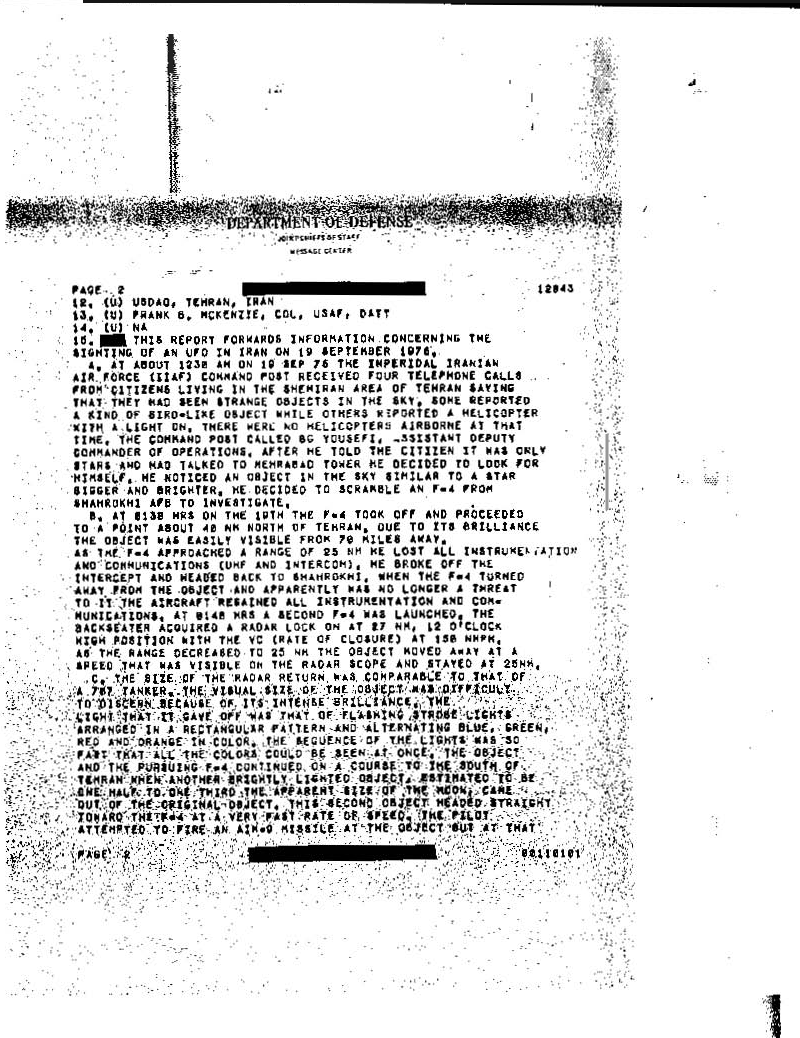
The incident began shortly after midnight when air traffic controllers at Mehrabad Airport in Tehran started receiving frantic calls from residents in the Shemiran district. People described a bright object, far larger and more luminous than a star, with flashing colored lights—blue, green, red, and orange—arranged in a rectangular pattern. Controller Hossein Pirouzi stepped outside and saw it himself: a rectangular shape with lights at either end and a smaller red light circling the middle. He alerted the Imperial Iranian Air Force command. General Youssefi, who also observed the object, ordered interceptors scrambled from Shahrokhi Air Base.
The first F-4 Phantom lifted off around 1:30 a.m. The pilot reported the object visible from 70 miles away due to its intense brilliance. As he closed to within 25 nautical miles (about 29 statute miles), every instrument on his jet failed. His UHF and intercom communications went dead. He broke off the intercept and turned away. Only then did his systems mysteriously return to normal. The object, described as roughly the size of a Boeing 707 tanker on radar and intensely luminous visually, had neutralized the jet’s electronics from a distance.
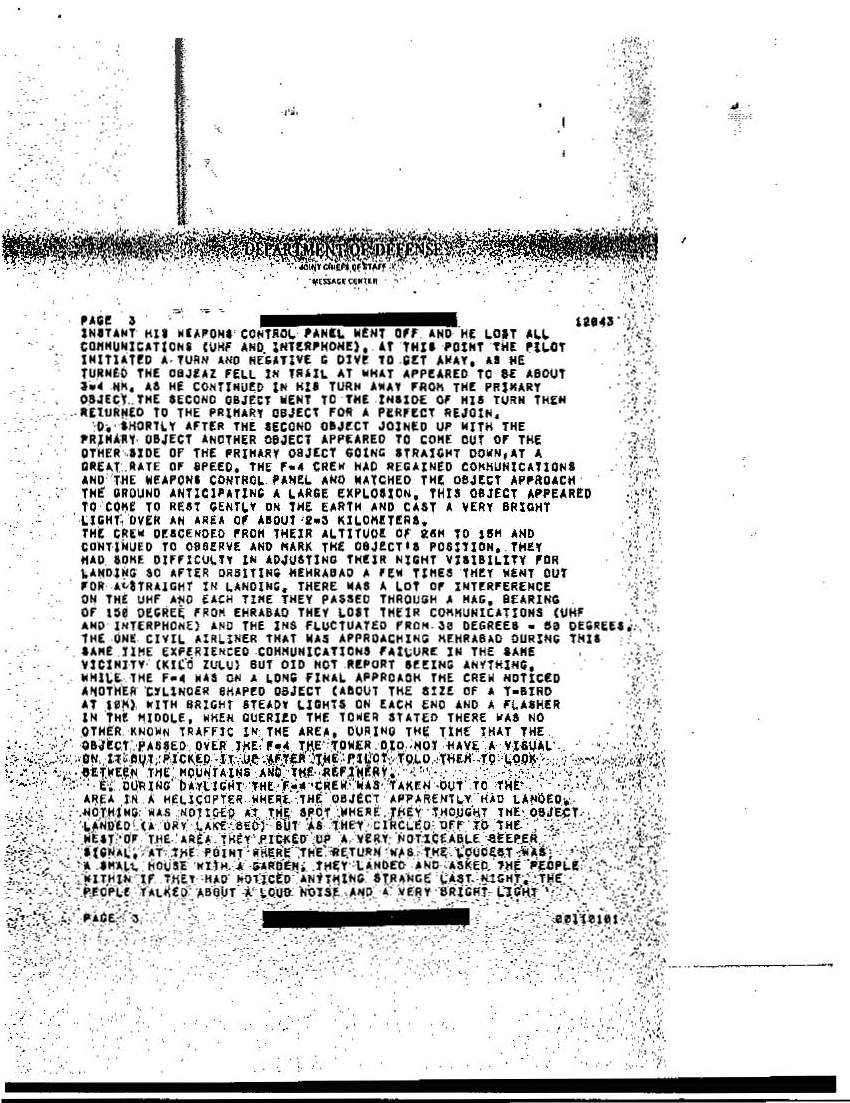
Ten minutes later, a second F-4 was launched. This one carried squadron commander Major Parviz Jafari (later Lieutenant General) and weapons officer First Lieutenant Jalal Damirian. Jafari acquired a solid radar lock at 27 nautical miles. As they closed, a smaller, round object detached from the primary craft and raced directly toward their Phantom “almost as if it were a missile,” Jafari later recalled. He prepared to fire an AIM-9 Sidewinder infrared-guided missile. At that exact instant — while the weapons panel was still live and the pilot was attempting to engage — the system suffered a sudden and total power loss. The weapons control panel went offline. UHF communications and the internal intercom failed simultaneously. The jet’s avionics were crippled precisely when the crew needed them most. Jafari broke away in a negative-G dive to evade. The smaller object fell into trail behind him for a few miles before rejoining the primary object in what witnesses described as a “perfect rejoin.” Only after the F-4 turned away and was no longer a threat did all instrumentation, communications, and weapons systems restore themselves.
Ground radar at Mehrabad had tracked the primary object the entire time. The interference was selective: it affected the intercepting aircraft but not ground systems. The object also released yet another bright object that descended rapidly toward the ground south of Tehran, landing gently and illuminating a one-to-two-mile area with intense light. Pilots marked the position. A later helicopter search picked up a strong beeper-like signal near a small house and garden. Residents reported a loud noise and a brilliant flash “like lightning.” No wreckage or obvious physical trace was found, though the area was checked for radiation.
These details come not from tabloid accounts or blurry videos, but from a detailed, contemporaneous U.S. Defense Intelligence Agency (DIA) Intelligence Information Report — a declassified teletype message sent the day after the incident. The report was matter-of-fact, almost clinical, in its description of radar returns, visual observations, and the precise timing of the electronic failures.

International Incidents of Interest news article on 1976 Iran incident
What makes the Tehran case especially significant is the documented U.S. government involvement. (See the full report at the end of the article)
At the time, Iran was a close Cold War ally of the United States. American advisors helped operate and maintain the F-4 fleet. The U.S. Defense Attaché’s office in Tehran promptly gathered the details. The resulting report was routed to an extraordinary list of recipients: the White House, the Secretary of State, the CIA, the NSA, the Joint Chiefs of Staff, the Defense Intelligence Agency, and multiple top military commands in Europe and the Middle East. Officials later described this distribution as “routine” for any significant event in the sensitive Middle East region. Yet the fact that a single UFO report reached the highest levels of the U.S. national security apparatus — including Henry Kissinger’s State Department — is telling.
The DIA itself evaluated the case highly. One internal assessment called it an “outstanding report” and a “classic” that met all the criteria for serious ufological study. In 1978, U.S. Air Force Captain Henry S. Shields authored a summary that appeared in an internal intelligence publication discussing electronic interference and jamming — treating the Tehran event as a noteworthy example of unexplained disruption to advanced military aircraft.
Tehran UFO Incident, 1976 Iranian Fighter Jets Chase a UFO
No public explanation was ever offered. No follow-up investigation results were released. The F-4s were among the most sophisticated fighters of the era, equipped with advanced American avionics and weaponry. The timing of the failures — coinciding exactly with weapons acquisition and attempted launch — raises obvious questions about the nature of the interference. Was it deliberate? Technological? Or something else entirely?
Decades later, Major Jafari and other witnesses have stood by their accounts in interviews. The declassified documents remain the strongest evidence: sober, official, and unclassified at the time of transmission, yet describing events that defy conventional explanation.
In an era when the U.S. government has slowly begun acknowledging UAP encounters involving its own military assets, the 1976 Tehran incident stands as a historical benchmark. It occurred in the skies of a key ally, involved U.S.-built aircraft, generated high-level intelligence reporting, and featured clear, repeatable electromagnetic effects on weapons and navigation systems. The primary object and its “probe” behaved with apparent intelligence — approaching, evading, and neutralizing a threat without causing permanent damage or escalation.
The Tehran incident stands as one of the strongest cases on record of an unidentified aerial phenomenon demonstrating both superior performance and the ability to neutralize military weapons systems. It occurred in a strategically sensitive region, involved U.S. allies and U.S. equipment, and generated high-level American interest. Yet it was never explained to the public. The same pattern persists today: official reports acknowledge the reality of anomalous objects demonstrating advanced technology, while transparency remains elusive.
We still don’t know what it was. But we do know this: the U.S. government was informed in real time, distributed the report to the highest levels, and then allowed the matter to quietly fade from public view. That pattern — detailed documentation followed by institutional silence — is one we have seen repeatedly in UAP cases. The Tehran incident deserves renewed scrutiny not because it proves extraterrestrial visitation, but because it demonstrates that unexplained aerial phenomena have, on at least one documented occasion, rendered sophisticated weapons systems inoperable in a combat-ready intercept scenario.
Transparency demands we ask the obvious questions. What else did U.S. intelligence learn from its Iranian counterparts and its own attachés? Were similar incidents reported elsewhere? And why, nearly fifty years later, does the public still lack a full accounting of what happened that night over Tehran?
We deserve better. Whether these objects represent foreign adversaries, secret U.S. programs, or something else entirely, the American people and our elected representatives have a right to the full facts—especially when the evidence shows these phenomena can disarm the very systems designed to protect us. The 1976 Tehran case is not ancient history. It is a warning, meticulously documented by the U.S. government itself, that we still have not fully heeded.
The pilots did their jobs. The radar operators did theirs. The documents were written and distributed. The rest — the explanation — remains classified in the only place that truly matters: the collective memory of the national security apparatus that received the report in September 1976 and has said almost nothing since.
**The Report**