The Face was never just a simple trick of light
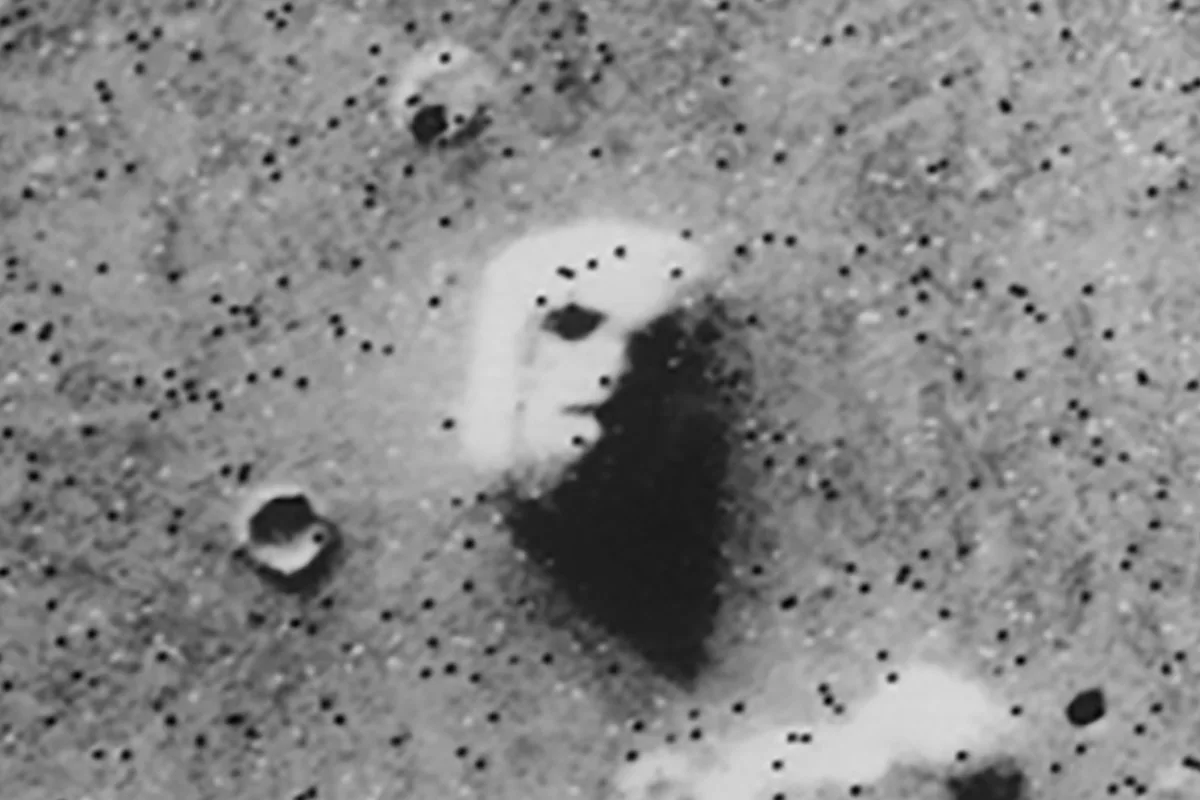
In July 1976, as Viking 1 orbited Mars searching for a safe landing site for its twin lander, the spacecraft’s camera captured a 1.2-mile-long mesa in the Cydonia region that looked uncannily like a human face staring upward. NASA’s own press release described it as a “huge rock formation in the center which resembles a human head.” The agency’s chief scientist, Gerald Soffen, quickly dismissed it as a “trick of light and shadow.” The image, Viking frame 035A72, was released with that framing. A second frame, 070A13, taken 35 orbits later under different lighting, showed the same feature still looking facial. Independent computer engineers at Goddard Space Flight Center, Vincent DiPietro and Gregory Molenaar, later rediscovered the frames in the archives and began examining them more carefully.
The Face on Mars
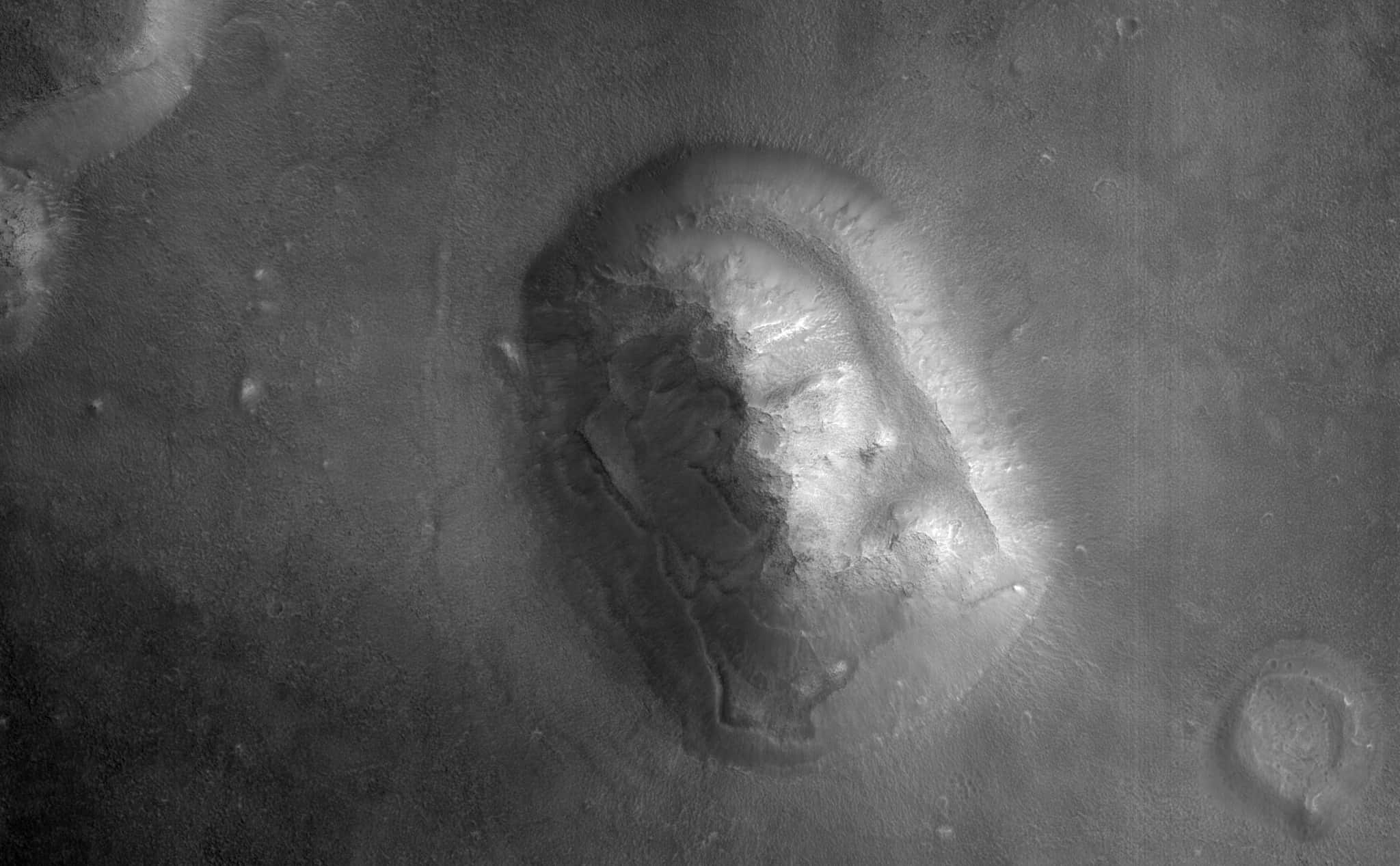
What followed was one of the most durable and revealing episodes in the history of planetary science and public communication about the possibility of non-human intelligence. For decades the official story has been simple: "pareidolia" plus low resolution plus convenient shadows. Higher-resolution images from Mars Global Surveyor in 1998 and 2001, and later from Mars Reconnaissance Orbiter’s HiRISE camera, supposedly settled the matter. The Face is just an eroded mesa. Case closed.
That official story has always been incomplete. It understates what independent analysts actually found in the data, glosses over persistent geometric and statistical anomalies, and treats the question of artificial origin as inherently unserious rather than empirically testable. The Face on Mars is not proof of extraterrestrial construction. But the evidence that it is a natural formation is weaker, and the anomalies more interesting, than the confident dismissals suggest. The institutional preference for quick closure over sustained open inquiry looks familiar to anyone who has followed the recent UAP disclosure debates.
What the Early Data Actually Showed
The original Viking images had a resolution of roughly 160 feet per pixel. That is coarse, but not so coarse that every facial feature was pure noise. Link to first raw NASA image. Link to second raw NASA image (35 orbits later). DiPietro and Molenaar’s enhancements, and later the more rigorous work of imaging scientist Mark Carlotto, revealed bilateral symmetry that survived different sun angles. Shape-from-shading techniques reconstructed a three-dimensional surface consistent with two eye sockets, a central ridge (nose), a mouth-like depression, and even subtle forehead markings visible in both frames. These were not single-pixel artifacts. Bit errors in the original transmission did create some of the dark spots that enhanced the “eyes” and “nostrils,” but removing them did not erase the overall facial organization.
Carlotto and colleagues went further. Using fractal analysis—an approach that measures how well terrain fits natural self-similar patterns—they found the Face to be the least fractal (least natural-looking) object across roughly 5,800 square miles of the surrounding Cydonia terrain. Natural mesas and buttes in the region scored as far more fractal. Artificial structures on Earth, by contrast, deviate from fractal models in the same way. The analysis was published in the Journal of the British Interplanetary Society in 1990. Carl Sagan received a copy. He did not embrace the artificiality hypothesis, but he recognized the method as a legitimate search technique for anomalous objects.
Nearby features compounded the oddity. A five-sided formation later dubbed the D&M Pyramid (after DiPietro and Molenaar) sits roughly 6–12 miles southwest. Independent measurements of its angles and alignments with the Face and other mounds produced repeated geometric relationships—right triangles, parallel lines, and orientations that clustered more tightly than random distributions of similar-sized hills would predict. Horace Crater’s statistical work on smaller mound configurations in the same area found right and isosceles triangles appearing far more frequently, and with greater precision relative to mound centers, than Monte Carlo simulations of random placements. The probability of such clustering arising by chance was calculated in the range of 10⁻⁵ to much lower, depending on the exact criteria. These numbers are not proof. They are flags that the null hypothesis of pure geological randomness is under strain.

Mars Cydonia region
The Face itself sits near the location of a former Martian equator relative to an earlier pole position, and its long axis orientation is roughly upright with respect to that older polar axis. Coincidence is possible. Coincidence piled upon symmetry, fractal anomaly, and geometric clustering becomes less comfortable.
The Higher-Resolution Images Did Not End the Debate
When Mars Global Surveyor obtained the first higher-resolution views in 1998 (about 13 feet per pixel) and especially the fully illuminated 2001 image (about 7 feet per pixel), the popular narrative declared victory for the natural explanation. The Face looked less face-like under overhead lighting. Mainstream coverage treated this as decisive.
Independent re-analysis told a more complicated story. Carlotto’s examination of the 2001 image found that the mesa still exhibits a high degree of bilateral symmetry along two axes. Using repeatable geometric constructions based on clearly resolved edges and features, the platform and overall form fit a consistent model of rectangles with a 4:3 side ratio—rectangles that are diagonally bisected by 3-4-5 right triangles. The eastern side appears partially covered by sand or dust, which would naturally obscure finer detail and reduce apparent symmetry. When that coverage is accounted for, the residual symmetry remains striking. The platform base shows linear edges and right angles that are atypical of purely erosional mesas of similar scale in the region.
HiRISE images from the Mars Reconnaissance Orbiter resolve objects down to under about 3 feet. They confirm the landform is heavily eroded. They do not, however, magically convert every linear edge, platform regularity, or residual facial organization into ordinary geology. Erosion can degrade an artificial structure over millions of years just as it degrades natural ones. The question is whether the remaining regularities are better explained by random erosion or by an original non-random form that has been degraded.
Critics correctly note that humans are wired to see faces. The counterpoint is that not every claimed anomaly is equally strong. Most “faces” on Mars or Earth disappear under slight changes in lighting or resolution. The Cydonia Face retained organizational features across multiple Viking lighting conditions, and independent quantitative tests (fractal deviation, measured symmetry, geometric clustering of surrounding features) produced results that deviate from the background population of landforms. That is not the same as finding a face in a cloud.
Why the Institutional Response Matters
NASA and the planetary science community had legitimate reasons for caution. Carl Sagan once famously stated "Extraordinary claims require extraordinary evidence". The early popular literature concerning the Face, particularly Richard Hoagland’s more speculative writings, mixed careful image work with overreaching claims about lost civilizations, hyper-dimensional physics, and deliberate cover-ups. That mixture of facts with nonsensical claims made it easy for the scientific community at large to dismiss the entire subject.
Yet the institutional pattern is familiar. The default posture has been ridicule and premature closure rather than systematic, publicly documented testing of the specific quantitative claims made by Carlotto, Crater, and others. High-resolution imaging of Cydonia was delayed for years by orbital geometry, dust, and prioritization. When the images finally arrived, the narrative emphasized the loss of the “face” illusion while downplaying residual geometric regularities that independent analysts continued to document. The Brookings Institution report from the early space age, which discussed possible societal impacts of discovering extraterrestrial artifacts, is often cited by more conspiratorial voices. One need not accept full conspiracy theories to notice that institutions have strong incentives to avoid open-ended questions that could upend funding priorities, public expectations, or the quiet assumption that we are alone.
Recent years have shown how poorly the same institutions handled UAP data. Credible military and intelligence witnesses described objects with flight characteristics beyond known technology. The initial response was denial and stigma. Only sustained pressure produced limited acknowledgments and the creation of formal study offices. The Face on Mars is older data, lower stakes in some ways, yet the same reflex appears: treat the anomalous as embarrassing rather than as a signal worth rigorous follow-up.
What Artificial Origin Would Imply
If the Face and associated Cydonia features are artificial, several non-exclusive possibilities exist. An indigenous Martian civilization that rose and fell when the planet was wetter and warmer is one. Visitors from elsewhere who left monuments is another. A third, favored by some researchers, is that the builders were related to terrestrial life—either through panspermia or through a much deeper shared history than current models allow. None of these requires accepting every claim made in popular books. They require only that we take the geometric and statistical anomalies seriously enough to test them properly with modern data and methods.
The scientific method does not demand that we accept artificiality. It demands that we not rule it out by assertion when quantitative tests keep returning non-random results. The Face is approximately 1–1.25 miles across and roughly 1,000 feet or more high. On Earth, structures of that scale built by humans leave unambiguous signatures even after heavy erosion. On Mars, with lower gravity, different atmospheric and aqueous history, and billions of years of additional time, the signatures would look different. We have never systematically searched for them with that possibility in mind.
A Better Approach
The correct response is neither credulous acceptance nor reflexive dismissal. It is to treat Cydonia as a legitimate target for anomaly detection. Reprocess the full archive of Viking, MGS, Mars Express, and MRO data with modern techniques, including independent fractal, symmetry, and statistical analyses published in open literature. Acquire new high-resolution stereo and spectral data specifically targeting the platform edges, the claimed geometric alignments, and the sand-covered eastern side of the Face. Compare the measured regularities against large control samples of other Martian mesas. If the anomalies disappear under rigorous testing, the case is closed. If they persist, the hypothesis of non-natural origin remains on the table.
For fifty years the Face on Mars has been treated as a cultural curiosity and a cautionary tale about human pattern-seeking. That framing has been convenient. It has also been incomplete. The data contain regularities that independent analysts have repeatedly quantified and that the official narrative has repeatedly minimized. Whether those regularities ultimately prove geological or artificial, the public deserves an open accounting rather than another round of confident reassurance that there is nothing to see. The universe is large. Mars was once more Earth-like. The possibility that something non-human left a mark there is not a threat to science. Treating the question as radioactive is.
Research Findings
Mark Carlotto’s fractal analysis is one of the more quantitative and technically grounded contributions to the debate over the Face on Mars and other Cydonia features. It was developed in collaboration with Michael Stein and published in 1990 in the Journal of the British Interplanetary Society under the title “A method for searching for artificial objects on planetary surfaces.”
Core Idea and Motivation
Natural terrain (and many natural phenomena) tends to be self-similar across scales—it looks statistically similar whether viewed from close up or farther away. This property is captured mathematically by fractals. Man-made or otherwise artificial structures typically break that self-similarity; they introduce sharp edges, regular geometry, or scale-specific features that do not follow a fractal power-law distribution.
Stein, working at The Analytic Sciences Corporation (TASC) in the mid-1980s, reversed the then-popular use of fractals in computer graphics (where they were used to generate realistic natural landscapes, as in the Genesis sequence of Star Trek II). Instead of synthesizing images, he used a fractal model to analyze real images and flag regions that deviate from natural fractal behavior. The method does not require training examples of the specific objects one hopes to find. It simply measures how poorly a local region fits a fractal model of the surrounding terrain. High model-fit error = anomalous / least natural.
Carlotto has described the advantage clearly: it can detect “any kind of object, even those that you’ve never seen before.”
How the Technique Worked
The algorithm examined the image intensity surface (closely related to the underlying topography under appropriate lighting) over a range of spatial scales within a sliding window (commonly a 21 × 21 pixel window in the published Mars work). It estimated both a local fractal dimension and, more importantly, a model-fit error that quantified deviation from the expected fractal (power-law) relationship. Bright areas in the resulting “model-fit error” image indicated the poorest fits—i.e., the least fractal regions.
The technique had already been tested on terrestrial satellite and aerial imagery for detecting vehicles, structures, and other man-made objects against natural clutter. Performance was best under lower sun angles (more shadow and topographic contrast) and degraded somewhat under high sun angles when surface detail washed out.
Application to the Viking Cydonia Images
Carlotto and Stein applied the same parameters (no special tuning) to Viking Orbiter frames of Cydonia, particularly the low-sun-angle frame 35A72 (and also 70A13). Results showed:
- The Face was the least fractal (highest model-fit error) object in the analyzed region.
- The analysis covered an area on the order of thousands of square miles (often cited as roughly 5,800 square miles when including adjacent frames).
- Secondary strong detections appeared in the nearby “City” complex, including a feature sometimes called the Fortress.
- In Carlotto’s later public presentations (e.g., 1993 International Tesla Society talk), he noted that the Face “stood out like a sore thumb.
The method therefore provided an independent, quantitative flag that the Face (and certain nearby objects) were anomalous relative to the surrounding Martian terrain under the fractal criterion.
Context and Reception
Carlotto sent the 1990 paper to Carl Sagan. Sagan replied by sending one of his own papers on detecting intelligent activity via deviations from black-body radiation curves—an analogous “deviation from expected natural behavior” approach. Carlotto has highlighted the parallel.
The fractal results formed one strand of Carlotto’s broader body of work, which also included shape-from-shading 3-D reconstruction (showing facial organization persisted under varied simulated lighting) and later geometric/symmetry analyses of higher-resolution Mars Global Surveyor imagery. In a 2007 JBIS paper he extended related ideas into a statistical classifier that combined fractal dimension, model fit, anisotropy, and rectilinearity, trained on terrestrial natural vs. artificial scenes and then applied to planetary features.
Limitations and Caveats
The original analysis used ~160 ft/pixel Viking data with known bit-error noise. Higher-resolution images (MGS, HiRISE) were not available for direct re-testing of the exact same algorithm at the time of the 1990 paper. Later higher-sun-angle images of Cydonia show reduced contrast, and Carlotto himself has noted that the method’s discrimination power is lighting-dependent. Mainstream planetary scientists have generally regarded the fractal flag as interesting but not decisive, emphasizing that unusual erosional mesas can produce outliers and that overall geological context favors a natural origin. The technique measures deviation from a statistical model of naturalness; it does not by itself prove artificial construction.
In short, Carlotto’s fractal analysis supplied an objective, example-independent metric that ranked the Face as the strongest anomaly in its local region under a well-motivated model of natural terrain. It remains one of the cleaner technical arguments in the literature that something about the Cydonia features departs from ordinary Martian geology in a measurable way. Whether that departure is best explained by unusual natural processes or by non-natural origins continues to be debated.
A Gallery of the Related Imagery
Below is a gallery of the most relevant images of the Face on Mars and surrounding Cydonia features. Click on any image to view it in full resolution and read its caption.