What is the evidence associated with NASA’s moon photographs and imagery that lead us to think there is a link to UFO’s and the ET Hypothesis? Or is there any such evidence that does link the moon to the ET Hypothesis? Well, that would depend on who you ask. NASA’s stance is summed up on Wikimili.com under the heading “The Extraterrestrial Hypothesis”. They state that “NASA frequently fields questions in regard to the ETH and UFOs. As of 2006, its official standpoint was that the ETH has a lack of empirical evidence.” and that “Despite public interest, NASA considers the study of the ETH to be irrelevant to its work because of the number of false leads that a study would provide, and the limited amount of usable scientific data that it would yield.” These sentiments by NASA officials are an echo of the conclusion of physicist Edward Condon via study done from 1966 to 1968 informally called the “Condon Report” where the University of Colorado was commissioned by the USAF to provide a scientific study of the most credible sightings and reports, and make a conclusion about the usefulness of further study of the UFO topic. It is hard to believe that a study completed in 1967 still holds sway over the opinions of the scientific community today, but it still does.
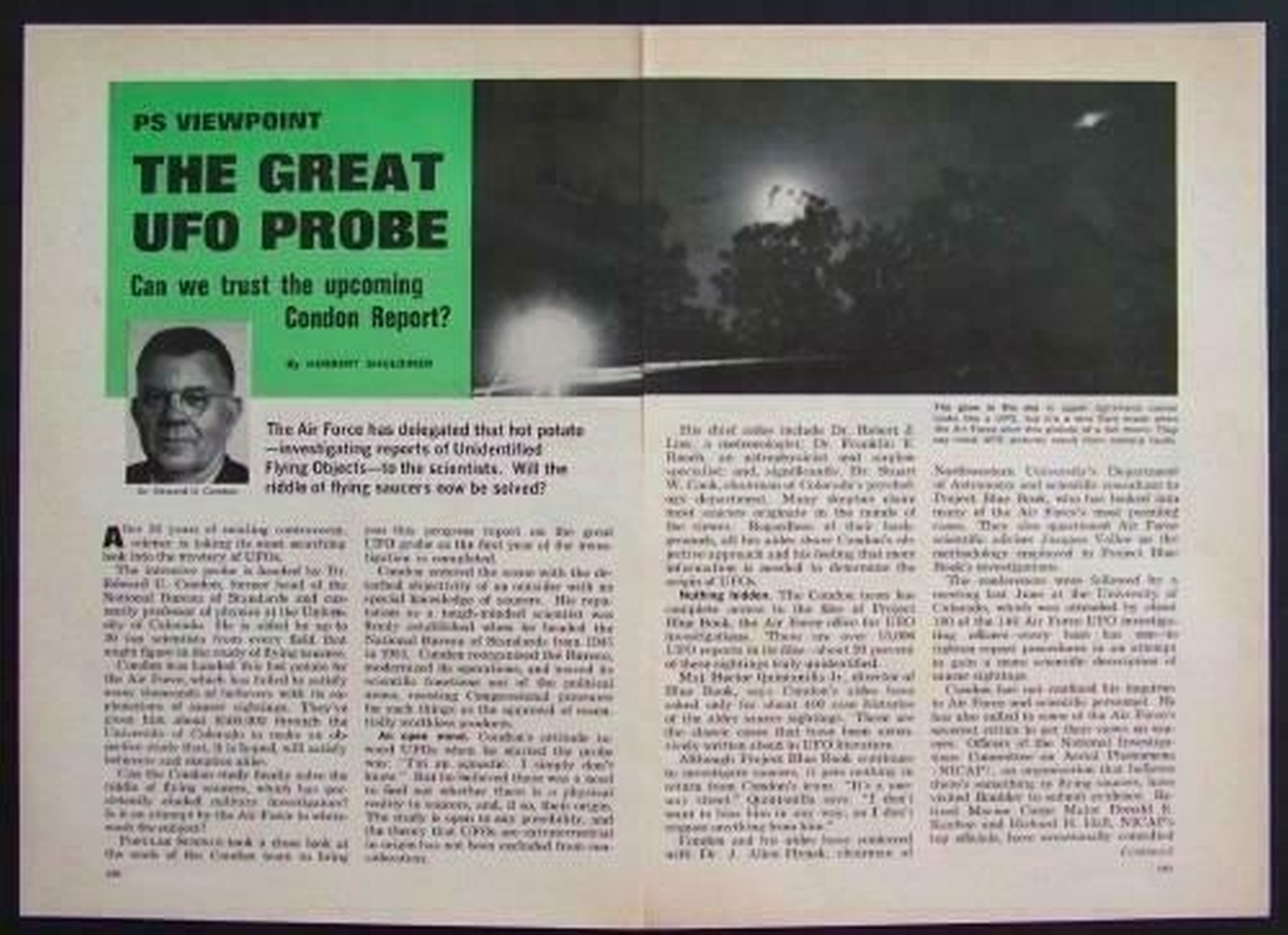
PS Viewpoint – The Great UFO Probe – Can we trust the upcoming Condon Report?
The origin of our moon is still in question today. To be sure, there are many theories, “The Giant Impact” being the leading scientific theory, but none of the current theories account for all the anomalies that can be found related to the moon. Also, the age of the moon has never been accurately determined. Scientists do say though, that they have figured out the most precise age for the Moon, thanks to samples of lunar rocks gathered during NASA’s Apollo 14 mission. Analysis of the rocks pinpoint the Moon’s creation to 4.51 billion years ago, just 60 million years after the Solar System first formed. The Moon dating technique, detailed today in the journal Science, involved breaking down the chemical components of a mineral within the lunar samples called zircon, according to lead study author Mélanie Barboni. Studying this mineral helped scientists figure out an important event in the Moon’s formation: when it solidified. The giant impact would have created a massive ocean of liquid magma that eventually coalesced into the Earth and the Moon. The chemical signatures of zircon allowed the scientists to estimate when the Moon’s solidification occurred — a key process that is often considered the beginning of the Moon’s life.
Below is a list of lunar anomalies. The list is not conclusive but it is a good start on the list of anomalies and anomalous activity associated with our nearest celestial neighbor.
Lunar Anomalies:
| # | Description of Anomaly |
|---|---|
| 1 | The diameter of the Moon is about 400 times smaller than that of the Sun. But the Moon is also 400 times closer to the Earth than the Sun. This ratio is an anomaly when compared to the rest of the solar systems moons. |
| 2 | Our Moon is the only known moon to have total eclipses of the Sun (blot out the Sun entirely). |
| 3 | Our Moon just happens to keep a nearly perfect circular orbit around the Earth. The only known moon that has this type of orbit. |
| 4 | It shocked scientists greatly when the seismic equipment on the Moon registered substantial reverberations on November 20, 1969, after the intentional jettisoning of the Apollo 12 lunar module’s ascent stage back to the surface (crashing the module on the surface). Not only did the Moon reverberate “like a bell,” it did so for over an hour. |
| 5 | The calculated mass of the moon does not equal it’s dimensions. It is lighter than it should be for its size (indicating it may be hollow or contain large voids). The moon’s mean density is 3.34 gm/cm3 (3.34 times an equal volume of water) whereas the Earth’s is 5.5. What does this mean? In 1962, NASA scientist Dr. Gordon MacDonald stated, “If the astronomical data are reduced, it is found that the data require that the interior of the moon is more like a hollow than a homogeneous sphere.” Nobel chemist Dr. Harold Urey suggested the moon’s reduced density is because of large areas inside the moon where is “simply a cavity.” MIT’s Dr. Sean C. Solomon wrote, “the Lunar Orbiter experiments vastly improved our knowledge of the moon’s gravitational field… indicating the frightening possibility that the moon might be hollow.” In Carl Sagan’s treatise, Intelligent Life in the Universe, the famous astronomer stated, “A natural satellite cannot be a hollow object.” |
| 6 | The Moon is littered with craters from many, many impacts over the many years of its existence. The craters are strangely uniform in terms of their depth. Accepted knowledge tells us that they should vary greatly in depth, yet they do not. |
| 7 | Many NASA and some Russian images of the moon show tall artificial looking anomalies on the surface. |
| 8 | It takes the Moon 27.3 days to orbit Earth once. At the same time, it also takes the Moon 27 days to do a complete rotation on its own axis. This “synchronous rotation” also referred to as “tidal lock” causes one hemisphere of the Moon to always face away from our planet. Our Moon appears to be unique in the solar system in this aspect also. |
| 9 | Many ancient writings speak of a time “before the Moon.” In turn, many scholars have quoted these works over the centuries. For example, Aristotle wrote of Arcadia, stating that the land was occupied “before there was a moon in the sky above the Earth.” Similarly, Apollonius of Rhodes spoke of a time “when not all the orbs were yet in the heavens.” |
| 10 | There are enough anomalies related to our moon to suggest a hypothesis that it is artificial and constructed to exact specifications of size and placed in orbit at exactly the right distance from earth to create the total solar eclipses we experience and that it was placed there to do exactly all that it does for the earth (the tides, etc.) |
| 11 | Only one planet in the solar system has a single moon. Earth. |
| 12 | The moon has a large mass of metal 180 miles below the surface 5 times the size of the big island of Hawaii. |
| 13 | Despite being a dead hunk of rock with very little geological activity, the Moon is prone to shaking fits. These earthquake-like tremors are called moon-quakes. The frightening thing about moon-quakes is that science has no real idea of what causes them. |
| 14 | Luna is the biggest moon in relation to its planet in our solar system. It is .27 (or just over a quarter) the size of the Earth. |
| 15 | There are five main theories concerning the origin of the moon. However, none of those theories explain all the anomalies related to our moon. |
| 16 | Heavier Elements on Surface: Normal planetary composition results in heavier elements in the core and lighter materials at the surface; not so with our moon. The maria are composed primarily illeminite, a mineral containing large amounts of titanium. |
| 17 | No Volcanoes: Some of the moon’s craters originated internally, yet there is no indication that the moon was ever hot enough to produce volcanic eruptions. |
| 18 | NASA, one year before the first lunar landing, reported 570+ lights and flashes were observed on the moon from 1540 to 1967. |
| 19 | Lunar Bridge: On July 29, 1953, John J. O’Neill observed a 12-mile-long bridge straddling the crater Mare Crisium. In August, British astronomer Dr. H.P. Wilkens verified its presence. |
| 20 | Water Vapor: On March 7, 1971, lunar instruments placed by the astronauts recorded a vapor cloud of water passing across the surface of the moon. The cloud lasted 14 hours and covered an area of about 100 square miles. |
All in all, there are many anomalies associated with our Moon. Obviously, not all are listed here. In fact there is a book created by NASA (see line item #18 in the list above) that contains more than 570 recorded sightings of anomalous lights and other phenomena from 1540 to 1967 by various astronomers and other individuals. It is an interesting read to say the least and here is a link to the NASA PDF of the original report. This table ends on October 15th 1967, however, I can’t imagine that this date is the actual end of the recorded anomalies associated with our moon. But for some reason there has been no additional publication by any “authoritative” sources of any further anomalies beyond the Oct. 1967 date. Is there further information on anomalies from Oct. 1967 to the present time? I would imagine that there exists a record somewhere of anomalies associated with the moon for that time frame, but the question is, “are we privy to that information”? It is possible that the information has become classified, just like real UFO evidence and information?
Below is the Ancient Astronaut Theorists take on the many moon anomalies.
Ancient Aliens: Are There Extraterrestrial Structures On The Moon?
Veering off topic for a moment, I would like to take the time to address a popular misconception about our Moon that concerns the rotational speed and the fact that we only ever see one side of it. Many people, when speaking about the side of the Moon that faces away from us, call it the dark side of the Moon. That term is misleading and it causes some people to actually believe that the side facing away from us is in perpetual darkness when, in fact, the entire surface (with the exception of the extreme points of the poles) receives sunlight. We try to discourage the use of the term the dark side because of that fact. Using “the back side” or “the opposite side” are, by far, more accurately descriptive terms to use rather than “the dark side” which only continues the misconception that our Moon actually has a “dark side”.
Obfuscation through misleading terms is part of the tactics employed by the “disinformation” and the “debunking” crowds alike and we should not assist them in their efforts to de-legitimize the UFO topic by allowing a known error to continue to proliferate through the UFO community. Education is one of the most effective tools available to us for the excision of arguments that we are all a bunch of gullible country bumpkins wearing tin-foil hats and are just dim-witted enough to think there actually is a dark side of the Moon. If we want to distance ourselves from this popular point of view, we must, at every opportunity, endeavor to dispel such notions with education, reason, and logic.
Moving along to the meat of this topic… The visual anomalies! So, we will begin exploring some of the more well-known anomalies first.
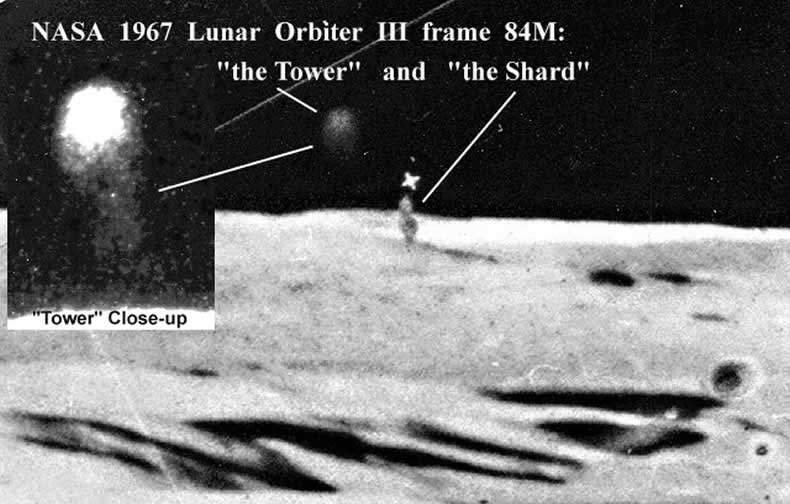
NASA’s Lunar Orbiter Frame 84M
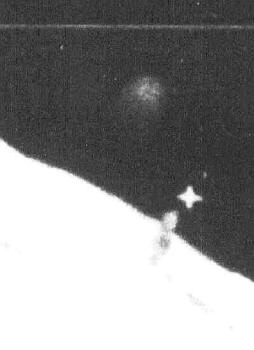
NASA’s Lunar Orbiter Frame 84M Shard Pic – Close Crop 1

NASA’s Lunar Orbiter Frame 84M Shard Pic – Close Crop 2
Out of all the anomalies associated with the Moon, the “Tower” as it is called, is probably the most well-known, especially in UFO enthusiast circles. When the “Tower” is brought up, it is a given that the shard is implied in the conversation because they are in such close proximity to each other. The Shard and the Tower kind of go hand-in-hand. The tower is estimated and measured to be more than seven miles high from the surface of the Moon, while the shard structure is estimated to be at least a mile high. The above images were taken by NASA’s Lunar Orbiter III and the Russian Zond 3 orbiter. (The star-like shape above the tower is a camera registration mark.) The tower is actually a separate structure from the shard. Though, the shard structure was discovered in the local vicinity of the tower structure. The tower structure has been cross-confirmed in multiple official photographs while the shard structure has only been seen in a single photograph. There is zero dispute about the reality of the tower or the shard. They exist. How they exist is a mystery. Something that tall on the surface of the Moon should not be possible if the hypothesis that, over many millennia, the Moon has been continually impacted by asteroids is true. Nothing this tall would survive. The fact that these monumentally tall structures exist lends credence to the ET Hypothesis because who else could have constructed these structures? There is zero plausibility in the idea that the structures are natural formations. They are a discovery by human kind, which points to the idea that these structures were not made by the human race and this leaves us with practically only one hypothesis to turn to… The ET Hypothesis.
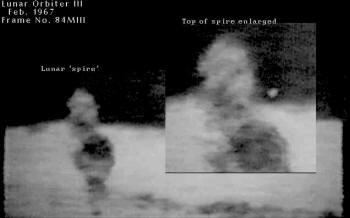
NASA’s Lunar Orbiter Frame 84M Shard Pic – Close Crop & Inset
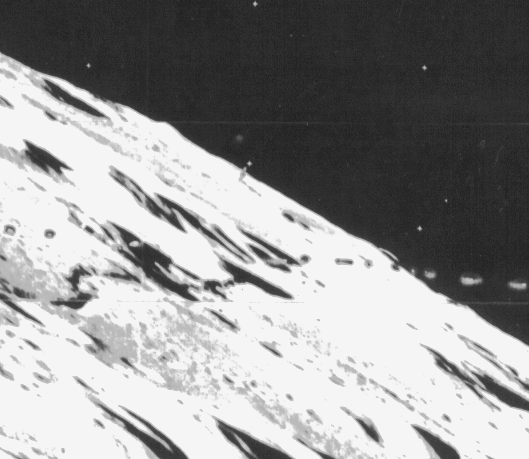
NASA’s Lunar Orbiter Frame 84M Shard Pic – Far Crop

Russian Photo – Zond 3 – Tower
There are many, many other Moon anomalies that can be found in the NASA documentation on this subject. The Apollo missions for example, and all the lunar surveyor missions as well. There a great deal of photographic evidence of lunar anomalies in the NASA Moon Mission archives. Here is a link to the NASA LRO missions. Also, here is a link to the NASA Apollo Missions. And one more… Here is the Complete list of NASA Moon Missions. I encourage you to research this topic for yourself and reach your own conclusions. There are so many anomalies concerning our Moon, that I feel you will discover for yourself that the evidence is overwhelmingly in favor of the ET Hypothesis.